

For over thirty years, my late colleague Graham Maule and I sent Christmas cards with original texts and designs. Most of the texts were carols, usually on the themes that Christmas cards avoided: the anonymity of the birth of Jesus, the awkwardness for Joseph of being a surrogate father, the savagery of the slaughter of the innocents. We also tried to imagine what might have been in the mind of the main players in the drama of God coming among us, hoping that such allusions might resonate with contemporary experience both personal and social.
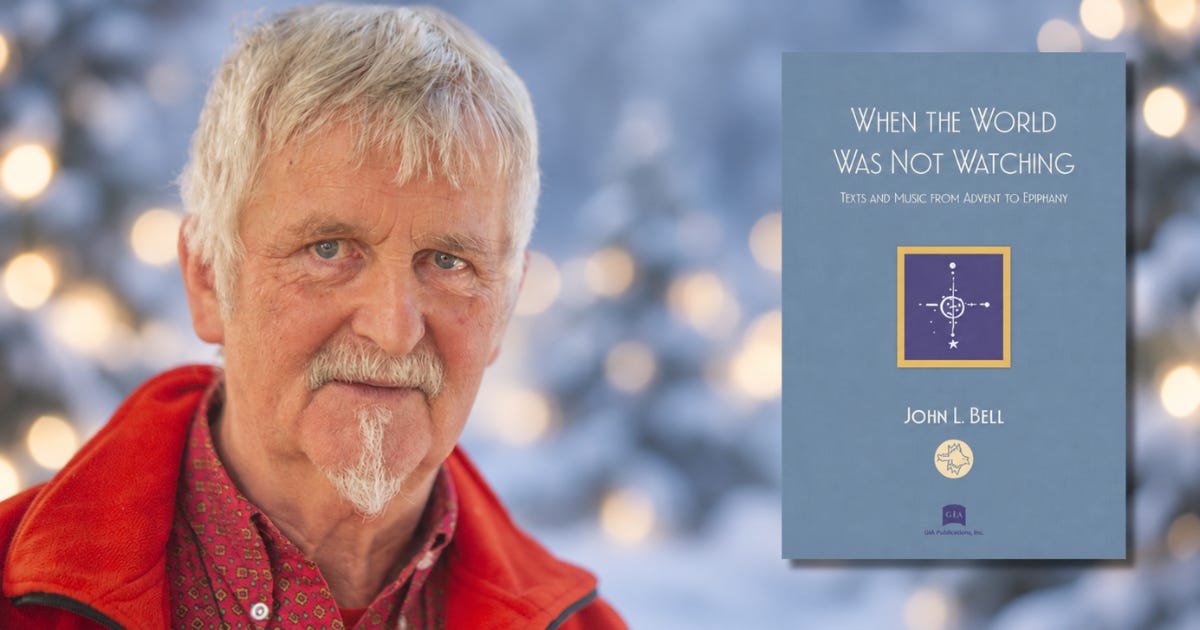
Most texts were never published commercially, but in a discussion with GIA Publications, our American publisher, it was suggested that there might be a new collection of materials for the full length of the season from the first Sunday in Advent to the last in Epiphany. This is what you now hold in your hands, and I hope in using the material you find engagement, enjoyment and spiritual nourishment.
-John L. Bell
What follows is a preview of this collection. Most songs are arranged for SATB choir and keyboard. The entire collection is available for purchase as a spiral volume or PDF. You can also purchase each individual song as a PDF download.
Advent
The Christmas story does not begin and end with the birth of Jesus.
As with any pregnancy, there are nine months of waiting and wondering for the parents and friends. It is a time of anticipation, of planning for the unknown, of preparing for something distinctly new.
We cannot in our celebrations completely represent the range of emotions that the families of Mary and Joseph would have experienced. But we can, in some measure, enter into solidarity with them by using the Sundays in Advent not so much to rehearse for Christmas, as to wait for it.
The commercial world will have besieged us with every well-known Christmas carol and ditty from Halloween onwards. The Church does not need to follow suit. Our Advent antiphons need to be supplemented by other songs and our liturgies with seasonal texts that combine the hope in ancient prophecies with contemporary desire for a better tomorrow. -John L. Bell
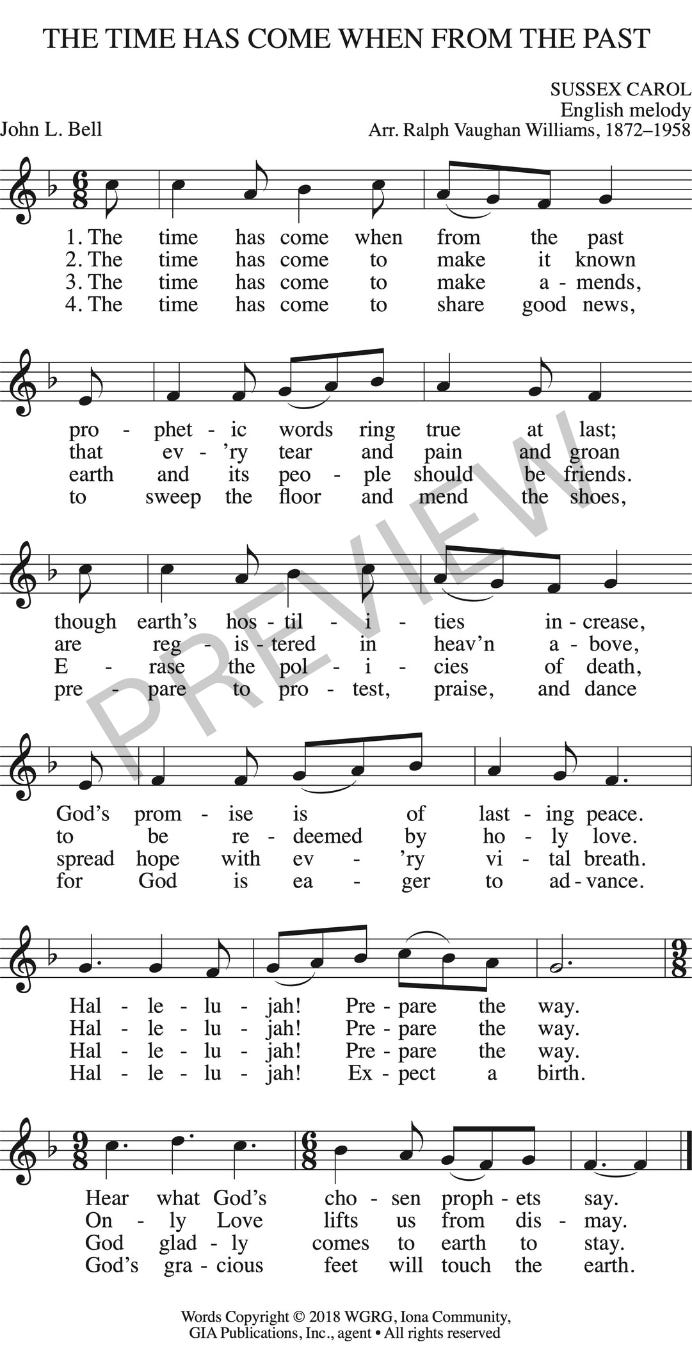
The Time Has Come When from the Past
A bright Advent song with the recurrent theme of preparing the way.
The tune SUSSEX CAROL is a seasonal favorite in Great Britain. It is an ancient melody rescued from oblivion and harmonized by the composer Ralph Vaughan Williams (1872–1958). lt is usually paired with the carol “On Christmas Night All Christians Sing.”
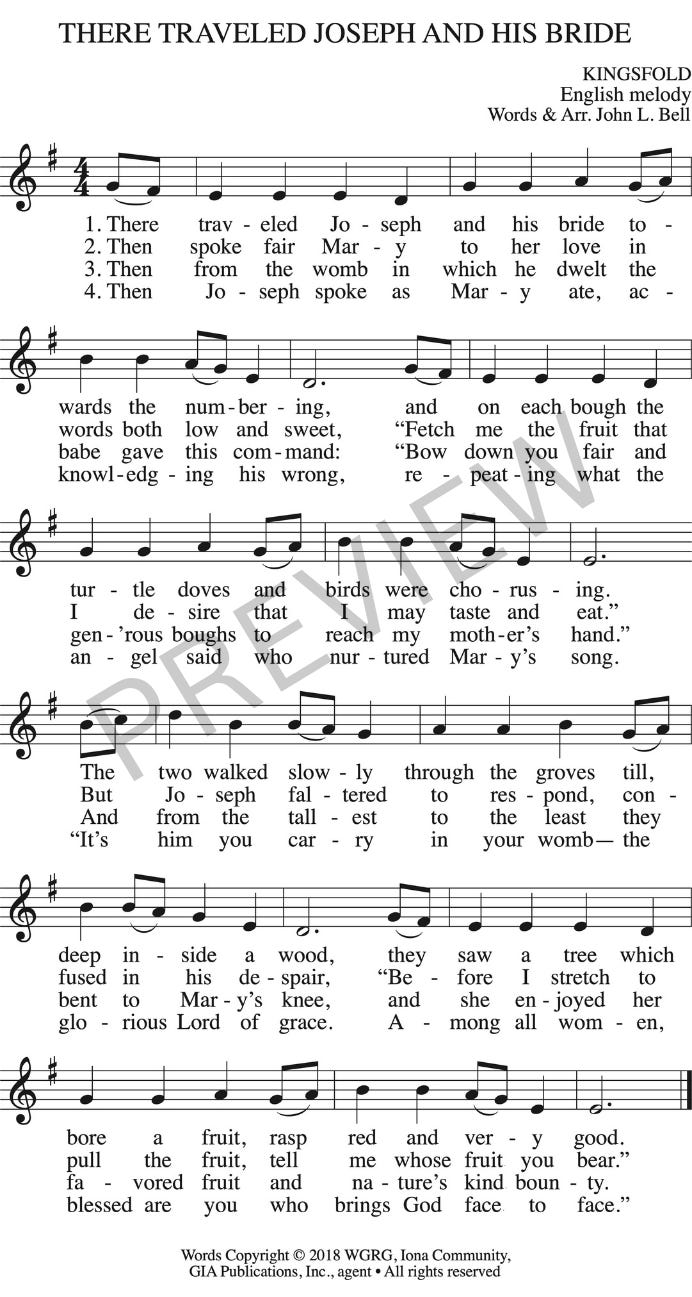
There Traveled Joseph and His Bride
This song is derived from an ancient Gaelic poem, “The First Miracle of Christ.” It was collected and translated by Alexander Carmichael (1832–1912) and included in his collection of Gaelic texts, Carmina Gadelica. The text bears some resemblance to that of the English “Cherry Tree Carol.” It is a lovely, imaginative poem, which articulates the hesitation in Joseph and the power of Jesus present in the womb.
The English folk tune KINGSFOLD is a good match for this text.
Nativity
The celebration of Christmas properly begins when, with confidence, we affirm the ancient words of Isaiah:
A boy has been born for us, a child given to us.
The Christmas cast then appear in glorious profile. But despite the need to give every child in a nativity play a special part, those who are immediately involved are very few. The Gospels never mention an innkeeper or his wife, a donkey, robins, snow, holly, ivy, mistletoe or a little drummer boy. These are accretions that have gradually crept in and sometimes almost eclipse both the main characters and the central significance of the festival: namely that God, by personal choice, has decided to come among us and be vulnerable to us out of nothing other than sheer love.
Mary, Joseph and the shepherds take center stage, but they are linked because they all have been addressed by angels. The Hollywood Christmas might be a feast for the eyes, but the simplicity (even the crudeness) of the first Christmas is a gift for the soul. -John L. Bell
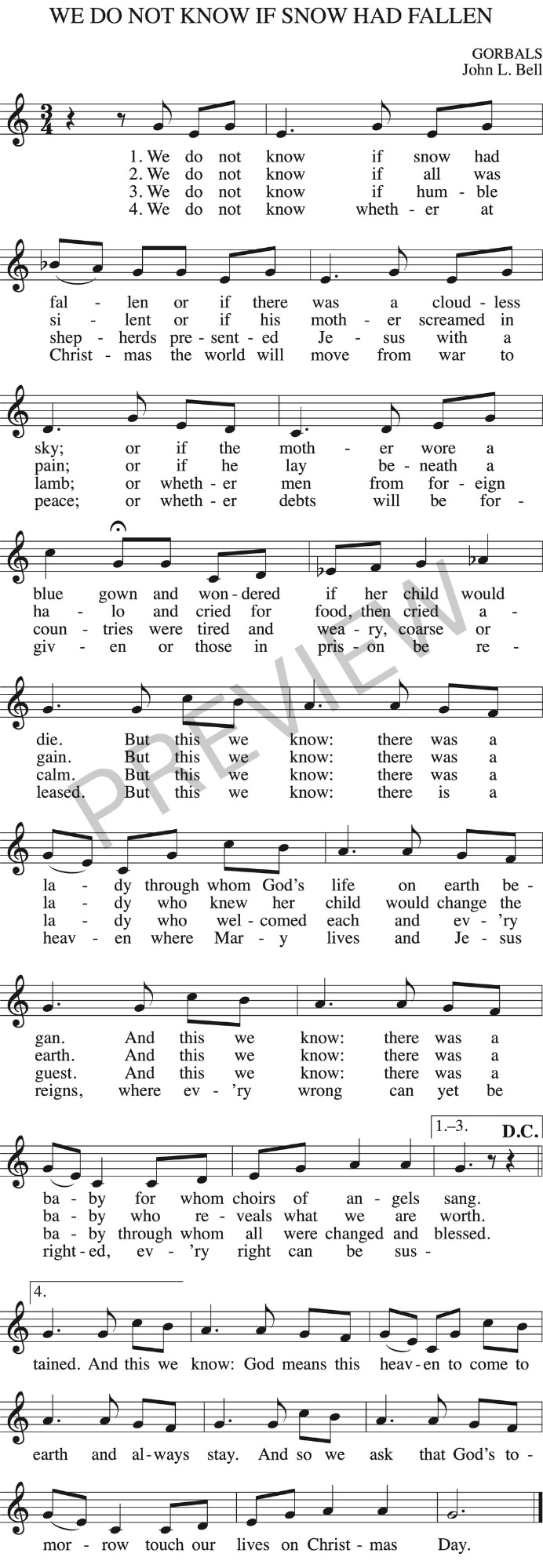
We Do Not Know If Snow Had Fallen
This song was written for a choir of children from different religious and ethnic backgrounds, some of whom lived in unusual or impoverished circumstances. As many of them would not know the Christmas story, the song was intended both to tell the story and to challenge some of the myths that have accreted over past centuries with regard to the birth of Jesus.
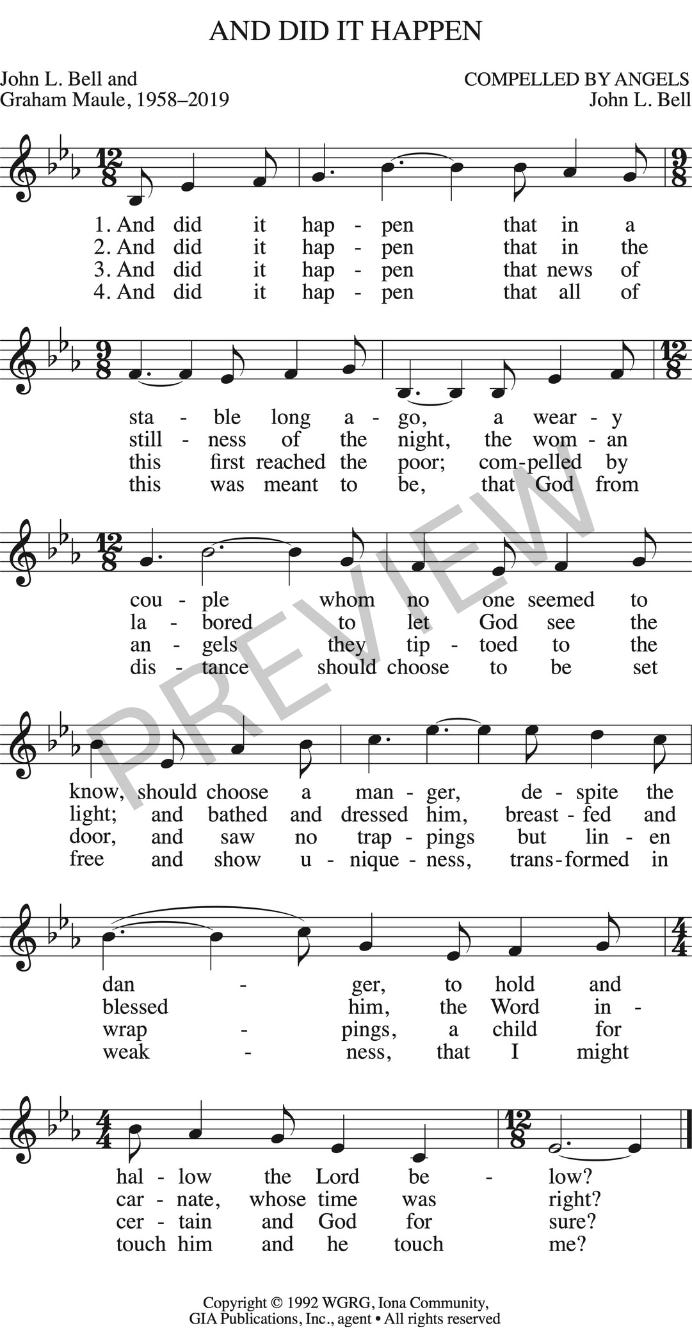
And Did It Happen
The wonder and mystery of the Incarnation should never be lost on us. We have continually to pinch ourselves and ask if this unbelievable event really happened.
Epiphany
In Epiphany we celebrate that it was not to a single family or to a “chosen”nation that Jesus came, but to the whole world. This had been alluded to centuries before in the writings of the prophets and the Psalms. But Jesus is also revealed to those in his own nation who kept alive the belief that one day God would come among us in person.
The consequence, of course, was that rumor of “the boy who would be king” led to his life being endangered and the need for the Holy Family to go into exile, living as refugees in a country that had once been hostile to Jewish settlers. -John L. Bell
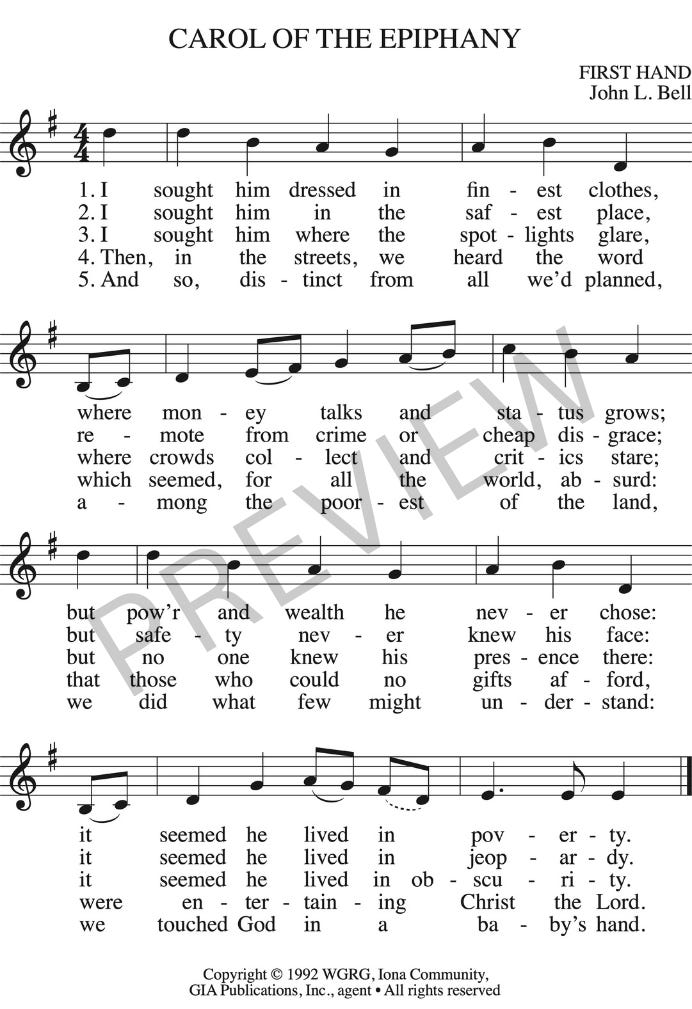
Carol of the Epiphany
For the best singing of this carol, the first four stanzas should be taken by soloists and the last by the assembly.
Child in the Manger
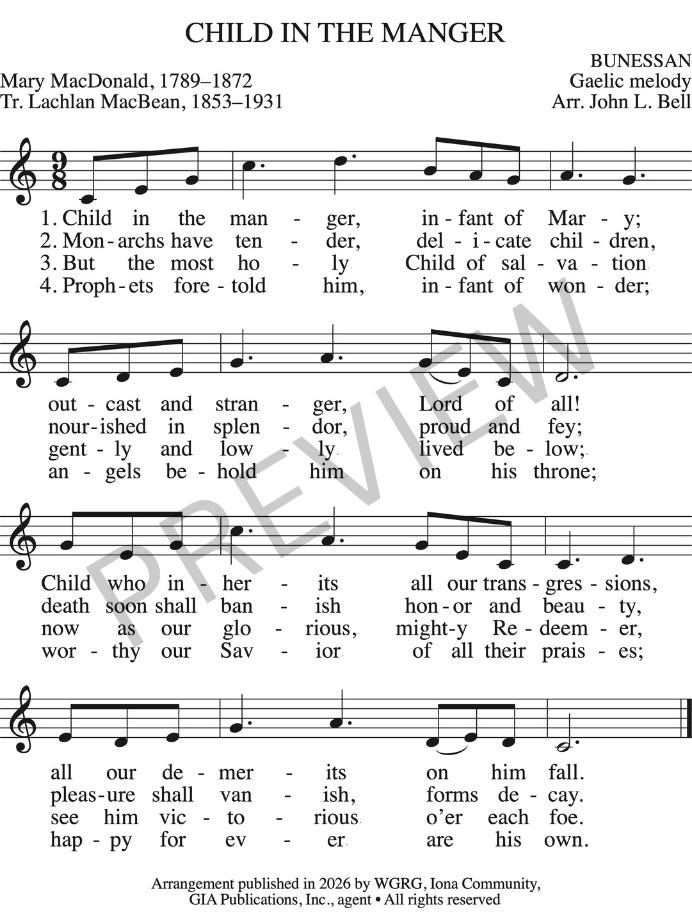
Mary MacDonald, a Gaelic poet living on the island of Mull, heard a tune played by a folk fiddler in the village of Bunessan and set these words to it. It is one of very few songs associated with Christmas that were sung in Scotland prior to the twentieth century; prior to that time, the nation, heavily influenced by Calvinism, held Advent, Christmas and Epiphany in low esteem.
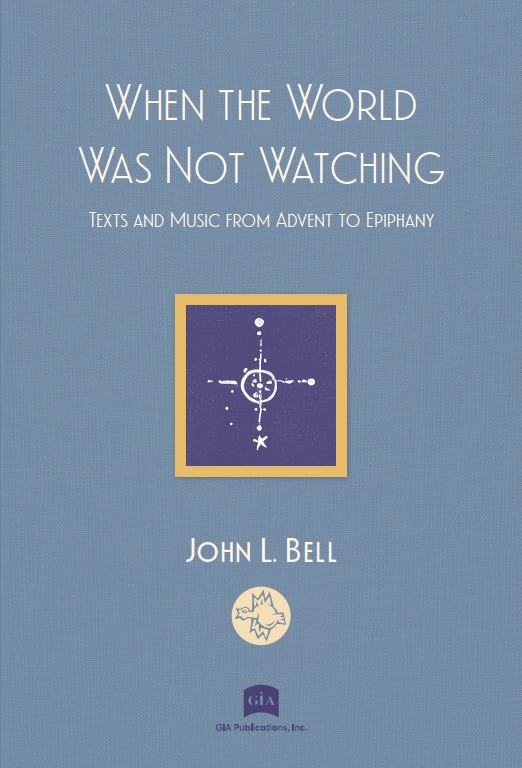
The whole collection with full arrangements, prayers, affirmations, and commentary is available at www.giamusic.com.
JOHN L. BELL was born in, resides in, and belongs to Scotland. Largely through interest expressed by GIA, his work and availability has become a North American reality. He is a liturgical composer who writes co-operatively with colleagues in Glasgow; he has a deep interest in music from non-European cultures and a passion for the song of the assembly.
Though his primary vocation is as a preacher and teacher, John spends over half his time working in the areas of music and liturgy, both at conferences and in small parishes. His work takes him frequently into Eastern Europe, Asia, Africa, and Australia.
With his colleagues, John has produced over fifteen collections of songs and octavos, and a wide range of liturgical materials, particularly for use by laypeople; he oversaw the production of a substantial hymnal for the Church of Scotland that, in North America, goes by the title Hymns of Glory, Songs of Praise (Canterbury Press).